
Extensometers
An extensometer is a precision instrument used in materials testing to measure the deformation (strain) of a specimen under applied load. It detects small changes in gauge length — the defined distance between two reference points on the specimen — and converts that displacement into strain data. Extensometers are used in tensile, compression, and flexure testing to generate accurate stress-strain curves and determine mechanical properties such as Young's modulus, yield strength, and elongation at break.
Quick Links to Products
Choosing the Right Extensometer
Selecting the right extensometer depends on your material, specimen geometry, test standard, and throughput goals. The three main types Instron offers each have distinct advantages — use the guide below to identify the best fit for your application.
Most Common
Clip-On Extensometers
Mechanical extensometers that clip directly onto the specimen via knife-edges or pivot arms. They measure strain by detecting changes in gauge length through a strain gauge or LVDT sensor.
Best For
Low-Volume Testing | Poisson's Ratio | High-Temperature | Rigid Materials
Key Considerations
High accuracy across a wide strain range
Works with standard flat and round specimens
Cost-effective for low-volume labs
May need to be removed before specimen fracture to avoid damage
Not suitable for very thin or delicate specimens
Automated
Automatic Contacting Extensometers
A motorised extensometer that automatically attaches to and releases from the specimen, enabling high-throughput testing without manual handling between specimens.
Best For
High-Throughput | Automated Test Systems | Axial and Transverse
Key Considerations
Eliminates manual attachment — reduces operator fatigue and error
Optional auto-detach before fracture
Consistent positioning across all specimens
Less convenient to move between testing systems compared to clip-ons
Not compatible with temperature chambers
Most Versatile
Non-Contacting Extensometers
Video extensometers are camera-based systems that optically track gauge marks or contrasting features on the specimen surface, measuring strain without any physical contact.
Best For
High-Throughput | Almost Any Material | High-Temperature | 2D Strain Mapping | Axial and Averaged Transverse | Closed-Loop Strain Control | r-Value
Key Considerations
No contact — no influence on specimen behavior
Single device suitable for almost any material
Can measure axial and transverse strain simultaneously
Requires good contrast between gauge marks and specimen
Quick Selection Guide
| If your requirement is… | Recommended extensometer type |
|---|---|
| Testing thin films or fragile materials that a clip-on would damage | Video extensometer |
| High‑throughput automated test cell with minimal operator involvement | Automatic contacting or video extensometer |
| Measuring both axial and transverse strain | Automatic contacting or video extensometer |
| Tight budget with moderate throughput on standard specimens | Clip‑on extensometer |
| Specimens that fracture explosively (i.e. composites) | Video extensometer |
| Complying with ASTM or ISO standards | See our FAQ below |
Find the Right Extensometer for Your Test

Non-Contacting Video Extensometers
A video extensometer is a camera-based extensometer that optically tracks gauge marks or contrasting features on the specimen surface to measure strain without physical contact. Capable of measuring strain on almost any material, video extensometers are particularly well suited for soft, delicate, or highly compliant materials where contact would influence the specimen's behavior or damage the device.
Recommended Use Cases
Multiple Gauge Lengths and Varied Elongations | High-Volume Testing | Ambient and Non-Ambient Applications | Axial and Transverse Strain Measurement | r-Value Determination | Closed-Loop Strain Control
Common Standards
ISO 527-2 | ASTM D638 | ISO 37 | ISO 178 | ASTM D882 | ASTM D412 | ISO 6892-1 | ASTM E8/E8M | ASTM A370 | ASTM E345 | ASTM D3039 | ISO 527-4 | ISO 527-5
Materials and Industries
Plastics | Metals | Composites | Thin Films | Foils | Soft Tissue | EV Battery
Available Models
For Universal Testing Systems
AVE3 Advanced Video Extensometer
Instron's highest-performance video extensometer for universal testing machines, designed for demanding applications and advanced materials research requiring the highest levels of accuracy and repeatability.
Features & Capabilities
Patent-pending CDAT airflow technology for up to 5× accuracy improvement
Supports closed-loop strain control
Single-point or optional averaged transverse strain measurement
Digital image correlation (DIC) capable for full field strain and displacement mapping
500 Hz data capture rate
For Universal Testing Systems

SVE3 Standard Video Extensometer
Instron's standard video extensometer for universal testing machines, delivering reliable and accurate non-contact strain measurement for everyday materials testing and research applications.
Features & Capabilities
Patented cross-polarized lighting technology reduces errors from lighting fluctuations
On-board measurement technology processes data in real-time
Allows for testing at ambient, high, and low temperatures
200 Hz data capture rate
Does not support strain control, transverse strain, or digital image correlation (DIC)

Automatic Contacting Extensometers
An automatic contacting extensometer is a motorized strain measurement device that automatically attaches to and detaches from the specimen under software control, eliminating manual handling between tests. It can be configured to remain on the specimen through fracture or to retract before failure, protecting the sensor where the test warrants it. Suited to high-throughput production testing and automated test cells where consistency, operator safety, and cycle time are critical.
Recommended Use Cases
Multiple Gauge Lengths and Varied Elongations | High-Volume Testing | Axial and Transverse Strain Measurement | Closed-Loop Strain Control | r-Value Determination | Ambient Testing Only
Common Standards
ASTM D638 | ISO 178 | ISO 527-2 | ASTM D412 | ISO 6892-1 Method A | ASTM E8/E8M Method B | ASTM A615 | ASTM A370 | ISO 10113 | ASTM E517 | JIS Z 2254 | ASTM D3039
Materials and Industries
Plastics | Metals | Composites | Elastomers
Available Models
For Universal Testing Systems
AutoX750 Axial Automatic Contacting Extensometer
Instron's automatic contacting extensometer for universal and static hydraulic testing systems, delivering high-accuracy axial strain measurement with automatic gauge length positioning for high-throughput metals, plastics, and composites testing.
Features & Capabilities
Automatic arm attachment and gauge length positioning eliminates manual setup between specimens
Arms can remain on specimen through failure or be configured to detach beforehand
Closed-loop strain control compliant with ISO 6892-1 Method A1 and ASTM E8 Method B
Meets ISO 9513, ASTM E83, and ISO 527-1 accuracy requirements
For Universal Testing Systems
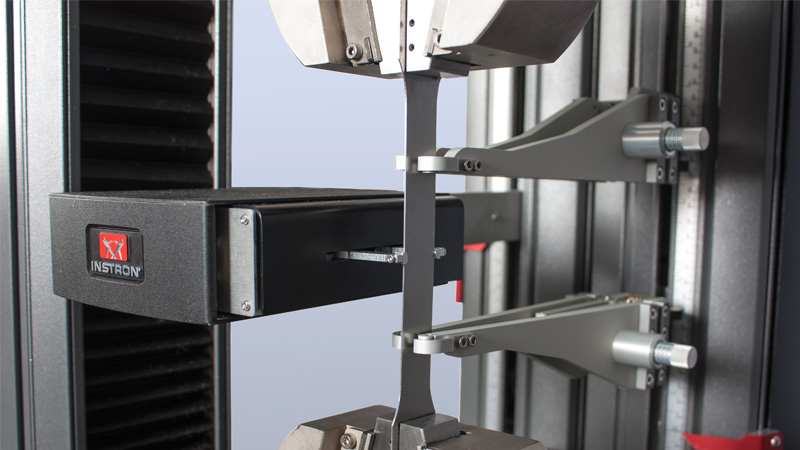
AutoXBiax Biaxial Automatic Contacting Extensometer
Instron's automatic biaxial contacting extensometer for universal testing systems, combining all the capabilities of the AutoX750 with simultaneous transverse strain measurement — enabling axial strain and plastic strain ratio (r-value) to be captured in a single test.
Features & Capabilities
Includes all features from AutoX750, plus:
Simultaneous axial and transverse strain measurement — no separate transverse extensometer required
Automatic centering improves repeatability by positioning in the center of your gauge length
Determine plastic strain ratio (r-value) in sheet metals to ISO 10113, ASTM E517, and JIS Z 2254

Clip-On Extensometers
Clip-on extensometers attach directly to the specimen via spring-loaded knife-edges, offering a precise and cost-effective solution for strain measurement across a wide range of materials and test types. Instron's clip-on range spans static and dynamic axial, averaging, biaxial, and transverse configuration — covering everything from routine static tensile testing through to high-cycle fatigue, compression, flexure, and full material characterization requiring simultaneous multi-axis strain measurement.
Recommended Use Cases
Low-Volume Testing | Poisson's Ratio | Testing Up to 200°C
Common Standards
ASTM D638 | ISO 604 | ISO 178 | ISO 527-2 | ASTM E8/E8M | ISO 6892-1 | ASTM D3039
Materials and Industries
Plastics | Metals | Composites
Clip-On Extensometer Types
For Universal Testing Systems

Static Axial Clip-On Extensometers
Instron's standard clip-on extensometers for static tensile, compression, and flexure testing, delivering accurate axial strain measurement on metals, rigid plastics, and composites to ISO 6892-1, ASTM E8, and ISO 527.
For Dynamic & Universal Testing Systems

Dynamic Axial Clip-On Extensometers
Instron's clip-on extensometers for cyclic and fatigue testing applications, delivering stable and accurate axial strain measurement over high cycle counts to ASTM E606 and ISO 12106.
For Universal Testing Systems

Averaging Axial and Biaxial Clip-On Extensometers
Instron's averaging and biaxial clip-on extensometers for tensile and compression testing of metals, composites, and rigid plastics, delivering mean axial strain measurement for precise modulus and Poisson's ratio determination.
For Universal Testing Systems

Transverse Clip-On Extensometers
Instron's transverse clip-on extensometers for tensile testing, delivering accurate lateral strain measurement perpendicular to the loading axis for Poisson's ratio determination to ASTM E132 and ISO 527.
Long Travel Extensometers
For Universal Testing Systems
Designed to measure strain across very large displacements, long travel extensometers accommodate materials that undergo significant elongation before fracture — such as rubber and other elastomers. Where a standard clip-on extensometer would bottom out at its maximum travel, a long travel design maintains accurate strain measurement throughout the full test.

High-Temperature Extensometers
For Universal Testing Systems
Designed for use inside furnaces and environmental chambers, high-temperature extensometers measure strain on specimens tested at elevated temperatures — up to 1200°C. The ceramic probe transmits displacement from the hot specimen to sensors located outside the heating zone, protecting measurement accuracy.
Recommended Use Cases
Metals | Aerospace Alloys | Ceramics | Energy Industry | ISO 6892-2 | ASTM E21 | ISO 204
Other Extensometers
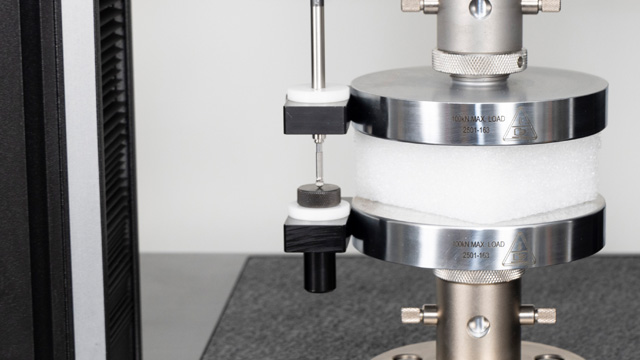

For Universal Testing Systems

Crack Opening Displacement Gauges
Instron's COD gauges for fracture mechanics testing, delivering accurate crack opening displacement for fracture toughness determination on metals and structural alloys to BS 7448, ASTM E399, and ASTM E1820.
For Universal Testing Systems
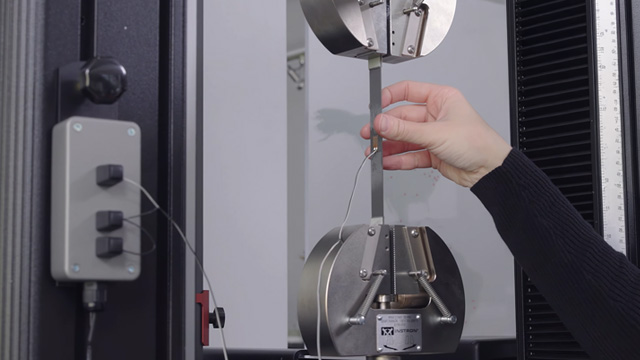
Bonded Strain Gauge Adapters
Instron's bonded strain gauge adapters for strain gauge-based testing, enabling standard electrical resistance strain gauges to integrate directly with Instron signal conditioning and data acquisition hardware.
Frequently Asked Questions (FAQs)
The table below outlines the extensometer types Instron generally recommends for common test standards. These recommendations are intended as a starting point — the most suitable extensometer for your application will also depend on factors such as throughput goals, lab setup, and specimen geometry. If you'd like a more tailored recommendation, speak to one of our application experts.
| Standard | Application | Recommended Extensometer |
|---|---|---|
| ISO 6892-1 | Tensile Testing of Metals at Ambient Temperature | Recommended: Video or Automatic Contacting Extensometer Acceptable: Clip-On Extensometer |
| ISO 6892-2 ASTM E21 |
Tensile Testing of Metals at Elevated Temperature | Recommended: High-Temperature Extensometer |
| ASTM E8/E8M | Tensile Testing of Metallic Materials | Recommended: Video or Automatic Contacting Extensometer Acceptable: Clip-On Extensometer |
| ISO 12135 ASTM E399 |
Fracture Toughness of Metals | Recommended: Crack Opening Displacement Gauge |
| ISO 527-2 ASTM D638 |
Tensile Properties of Plastics | Recommended: Video or Automatic Contacting Extensometer Acceptable: Clip-On Extensometer If testing for Poisson's ratio, a transverse or biaxial clip-on extensometer is required. |
| ISO 178 ASTM D790 |
Flexural Properties of Plastics | Recommended: Video or Automatic Contacting Extensometer Acceptable: Clip-On Extensometer Each extensometer listed above must be used in conjunction with a flexural deflectometer for this test. |
| ASTM D3039 | Tensile Properties of Polymer Matrix Composites | Recommended: Video Extensometer Acceptable: Clip-On Extensometer or Strain Gauge If testing for Poisson's ratio, a transverse or biaxial clip-on extensometer is required. |
| ISO 37 ASTM D412 |
Tensile Properties of Rubber and Elastomers | Recommended: Video Extensometer Acceptable: Long Travel Extensometer |
For more detail on individual test standards and extensometer requirements, explore Instron's library of ASTM and ISO standard guides.