

ASTM F2193
A Guide to Static and Cyclic Fatigue Testing of Surgical Fixation Devices
Written by Toby Lane
ASTM F2193 outlines testing of individual metallic screws, plates, and rods used in spinal implant constructs. Sub-assemblies of these components are tested in accordance with ASTM F1798 (Standard Test Method for Evaluating the Static and Fatigue Properties of Interconnection Mechanisms and Subassemblies Used in Spinal Arthrodesis Implants). The most common standard encountered is ASTM F1717 (Standard Test Methods for Spinal Implant Constructs in a Vertebrectomy Model). ASTM F1717 outlines the testing of full spinal constructs made up of these components and sub-assemblies.
We recommend reviewing the standard fully to understand all of its requirements.
Test System
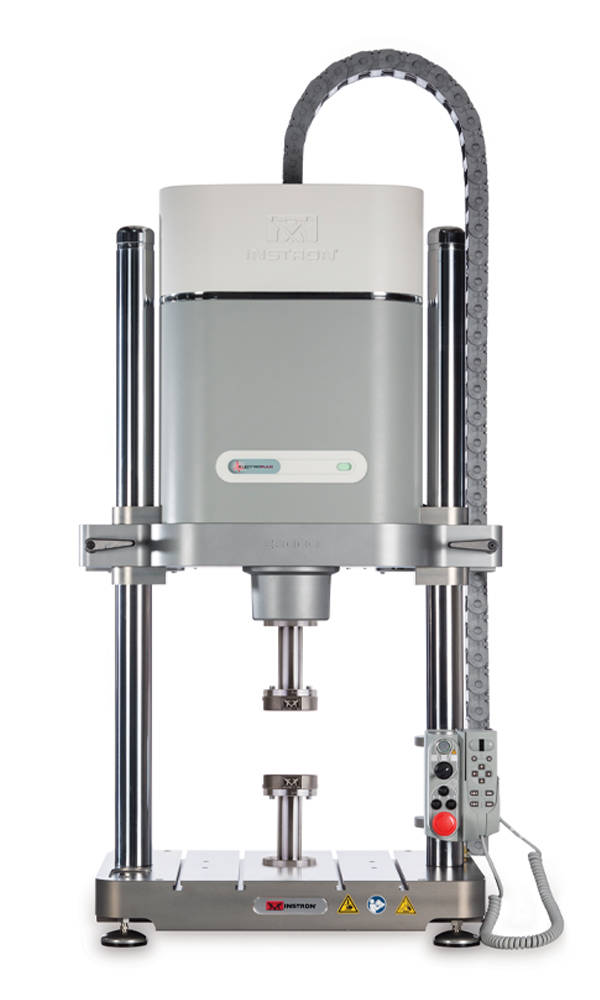
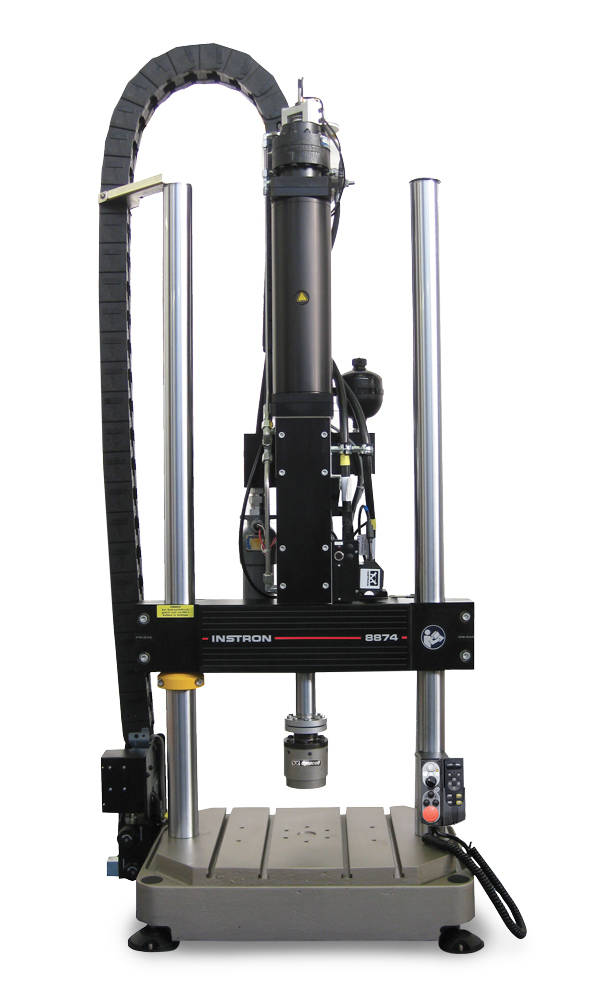
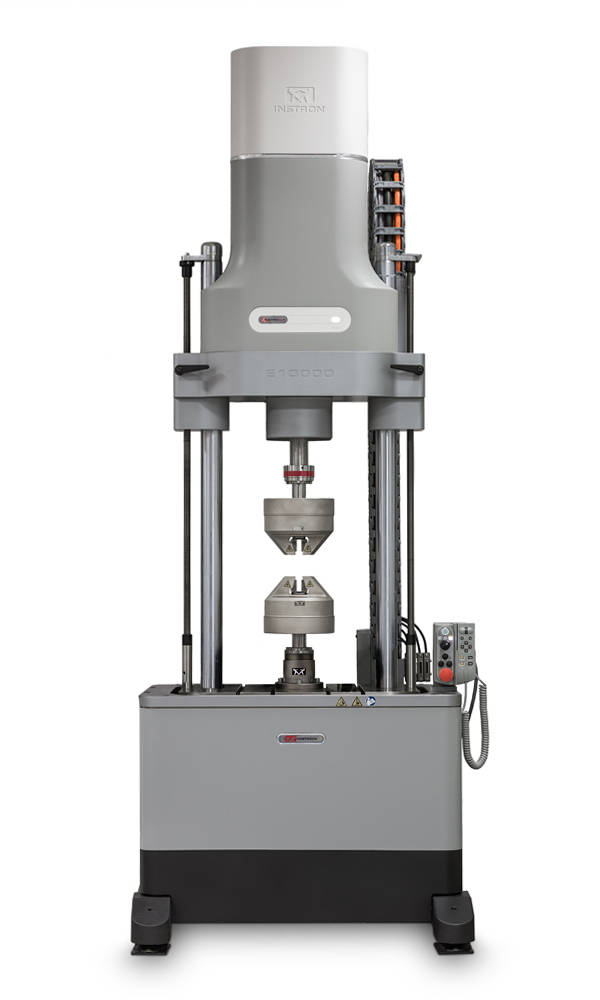
Both the static and fatigue tests can be carried out on a single dynamic test frame, such as the ElectroPuls® E3000 or ElectroPuls® E10000 All-Electric Dynamic Test Instruments. For customers with servohydraulic infrastructure, the 8872 and 8874 test frames would also be suitable options for this testing.
Test Parameters
Both spinal plates and rods are tested via the same four-point bending procedure to determine the stiffness, yield moment, ultimate moment, and fatigue runout moment at 2,500,000 cycles. First, static testing at a displacement rate up to 10 mm/min is carried out for a minimum sample size of 5 specimens.
Standard At A Glance
Materials
- Metals
Standard
- ASTM F2193
- ASTM F1717
- ASTM F1798
- ASTM F2706-18
- ISO 12189-8
Test Types
- Flexure
- High Cycle Fatigue
The fatigue test follows, with at least 2 specimens tested at each load level. Three load levels must be used to provide a minimum of 6 data points. The specimen must not fail after 2,500,000 cycles at one of these load levels, so that the fatigue runout moment can be identified. Load values can be determined by the user, or should correspond to 75%, 50%, and 25% of the static yield moment.
For the dynamic tests, an R ratio of 0.1 is used for thoracic and lumbar components, and -1.0 for cervical spine components (to illustrate reverse loading). Testing can be done up to 30 Hz in all cases.
For spinal screws, loading is done through cantilever bending. The threaded section of the screw should be embedded into a 10 mm long synthetic test block, to which the axial load will be applied. The head of the screw is then restrained using an anchoring fixture attached to the testing system. Typically, screws should have 10 mm of their length embedded into the test block, leaving around 5 mm of threads exposed between the block and the anchored head. For smaller screws, approximately one-third of the screw's entire length should be embedded in the test block. By applying force at the middle of the test block (5 mm from the end of the screw), all screws of a certain length — regardless of diameter — should experience the same acting moment.
Static tests should be carried out with a loading rate no greater than 25 mm/min, for a minimum of 5 samples, to create load-versus-displacement graphs.
Fatigue tests should be completed with a sinusoidal waveform at a maximum of 30 Hz and an R ratio of 0.1 for thoracic and lumbar screws. Again, an R ratio of -1.0 should be used for cervical screws. The procedure should then follow the same approach as the other two components: at least 2 specimens tested at each load level, 3 load levels used to create 6 data points, a maximum of 2,500,000 cycles, and 75%, 50%, and 25% of the static yield moment acting as starting points for loading values.
For all components, testing can be completed in other environments (namely saline solution) with justification and quotation of characteristics such as temperature, pH, and solution strength.

Talk to an Instron Expert
Not sure which test system fits your ASTM F2193 testing requirements? Tell us about your application and we will help you find the right solution.
Talk to an Applications Engineer
Tell us about your testing needs, and we'll help you configure the right frame, load cell, grips, and software for your lab. Please complete the form below, and we'll respond within 1-2 business days. For a faster response, call +1-800-473-7838 or +1 781 828 2500 if you are outside of the US.
