

ISO 11443: Extrudate Swelling
What Is Die Swell?
Die swell, also known as extrudate swell, is common in plastics processing, especially in polymer extrusion, in which a stream of polymeric material is forced through a die to produce the desired product geometry. This is related to the elasticity of the polymer, due to the macromolecular system's ability to contract and expand: when the random coil of macromolecules enters the capillary die, it undergoes a contraction which, after partially relaxing within the capillary, is recovered at the outlet, once the restraining effect of the capillary ceases.
The effect of swelling can be very strong, particularly with polyolefins (polyethylene, polypropylene) and certain polyamides and polyesters.
Swelling is critical in some polymer processes, particularly blow molding, where either inadequate or too much swell can cause processing problems and defects in the finished product. ISO 11443 specifies a method for measuring die swell using capillary rheometer accessories.
Testing Example: Die Swell of LLDPE Filled with Calcium Carbonate
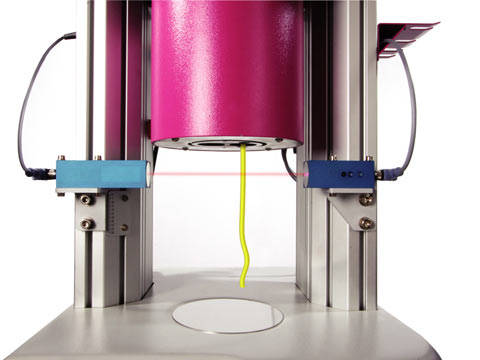
We were asked to perform a die swell test. Using the Die Swell Tester accessory on our capillary rheometer, we tested a sample of LLDPE filled with calcium carbonate. The measurement is performed using a laser system placed below the capillary die, which measures the diameter of the extrudate.
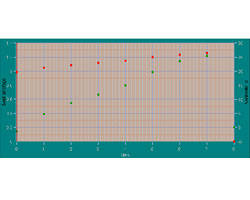
As shear rates increased, so did the die swell, showing a 25% increase in diameter at the processing shear rate. By measuring die swell with different capillary dies at various temperatures — the main parameters affecting elasticity — we were able to suggest the most suitable process conditions to achieve the desired finished product shape.

Talk to an Instron Expert
Not sure which capillary rheometer or accessory fits your die swell testing needs? Tell us about your application and we will help you find the right solution.
Talk to an Applications Engineer
Tell us about your testing needs, and we'll help you configure the right frame, load cell, grips, and software for your lab. Please complete the form below, and we'll respond within 1-2 business days. For a faster response, call +1-800-473-7838 or +1 781 828 2500 if you are outside of the US.
